Create a Culture of Health That Lasts
Many people set out to adopt healthier behaviors—such as improving diet, increasing physical activity, or managing stress—only to find that sustaining these changes long-term is far from simple. A study by John Norcross and colleagues at the University of Scranton found that 77% of Americans kept their New Year's resolutions for the first week, but only 19% maintained them over two years. Workplace wellness programs can either reinforce or undermine individuals' efforts to maintain these changes, directly impacting their long-term health outcomes.
While one-off programs or challenges may provide a temporary motivation boost, true behavior change requires ongoing, consistent encouragement. Continuous wellness programs step in where short-term solutions fall short. These initiatives are designed to support employees’ physical, mental, and emotional well-being year-round.
A continuous wellness program isn’t a “set it and forget it” initiative; it’s a commitment to fostering an environment where employees can prioritize their health in manageable, sustainable ways. These programs typically offer a mix of wellness activities—ranging from holistic challenges and on-demand resources to educational workshops and live events—that are engaging, accessible, and adaptable. Regular wellness support leads to healthier employees who are more focused, engaged, and productive, providing tangible benefits to both individuals and employers.
The Case for Continuous Wellness: Are Challenges Enough?
Wellness challenges are a great way to spark engagement, build camaraderie, and encourage healthy behaviors—but a single challenge alone isn’t enough to create a lasting culture of health. While challenges can boost short-term motivation, their impact often fades once they end. To create real, sustained change, organizations need ongoing wellness programs that provide year-round support, education, and resources. These continuous efforts help employees maintain progress over time, making it easier for them to stay on track long after a challenge ends.
Key Differences: Challenges vs. Continuous Wellness Programs
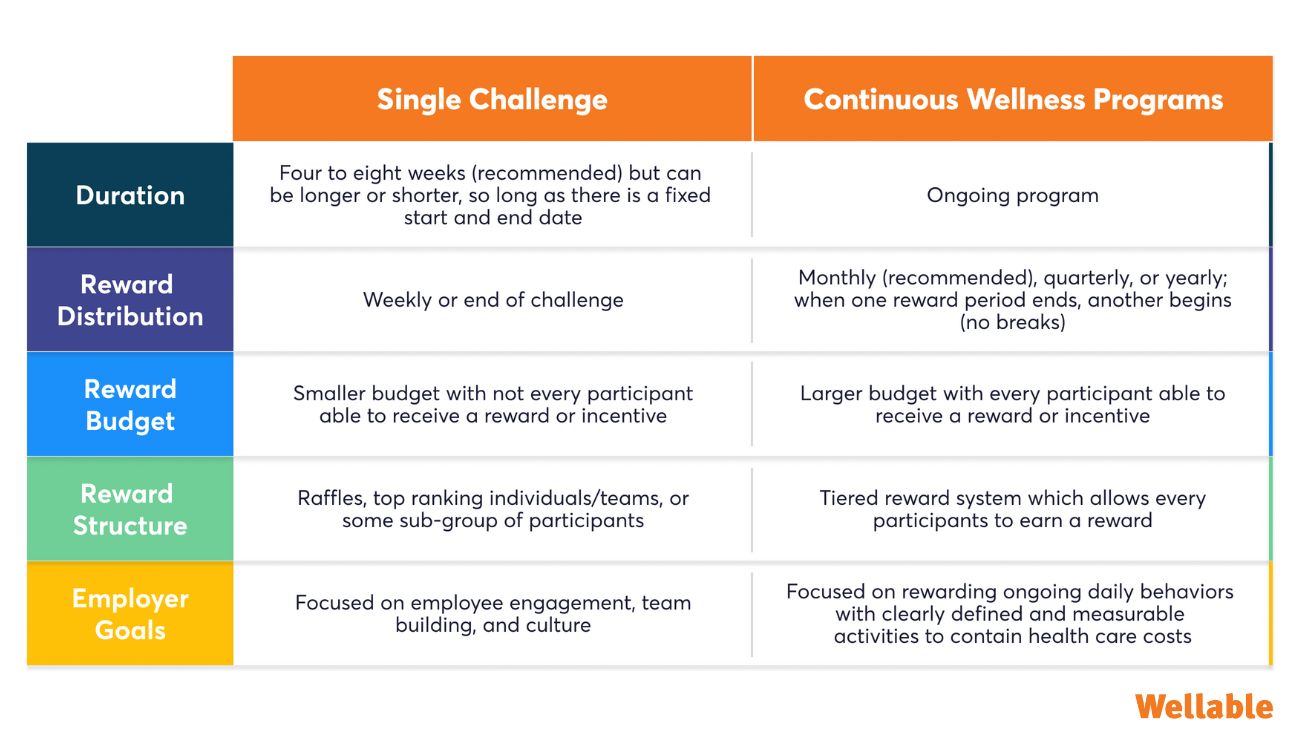
Wellness initiatives can take many forms but understanding the strengths and limitations of different approaches helps organizations make informed decisions. While wellness challenges offer a quick boost in engagement, continuous wellness programs provide long-term benefits that contribute to a healthier, more productive workforce.
Wellness Challenges Prioritize Short-Term Engagement
Wellness challenges are popular for driving immediate participation and excitement. They create a structured way for employees to focus on specific health goals, often using friendly competition and incentives to boost motivation. However, their impact can be short-lived if not followed by ongoing support.
- Increased engagement: Employees are more likely to participate in a challenge with a clear start and end date.
- Opportunities for experimentation: Allow employees to try new wellness activities in a structured way.
- Measurable short-term results: Can help track participation and improvements over a set period.
- Limited long-term impact: Employees often revert to old habits once the challenge ends.
- One-size-fits-all approach: Challenges may not accommodate varying health needs, abilities, or preferences.
- Engagement drops off quickly: Motivation tends to fade without continuous reinforcement.
To build a true culture of health, organizations can boost lasting engagement by running consistent challenges throughout the year or implementing a comprehensive annual wellness program. These approaches provide continuous motivation, accommodate diverse needs, and help employees sustain healthier behaviors over time.
Continuous Wellness Programs Drive Long-Term Impact
Continuous wellness programs create a culture of health in the workplace, where well-being is embedded into daily operations rather than treated as an occasional initiative. Research from the American Journal of Health Promotion found that sustained wellness programs can lead to a 25% reduction in absenteeism and a 32% decrease in healthcare costs over time, benefiting both employees and employers.
- Encourages lasting behavior change: Provides year-round support, making it easier for employees to build and maintain healthier habits.
- More inclusive and flexible: Offers a variety of activities and resources that accommodate diverse employee needs.
- Leads to measurable health improvements: Supports long-term reductions in absenteeism, stress, and chronic disease risks.
- Requires ongoing investment: Needs continuous funding, leadership buy-in, and dedicated resources.
- Takes longer to see results: The benefits unfold gradually rather than delivering immediate impact.
- Demands strategic planning: Requires thoughtful program design to ensure engagement and effectiveness.
A culture of health drives organizational success by reducing costs associated with lost productivity, improving employee performance and satisfaction, enhancing engagement, serving as a tool for talent acquisition and retention, and fostering a positive work culture. While it requires more time and effort to implement, the long-term benefits are well worth it.
To learn more about whether an annual wellness program or a one-time challenge is right for your organization, check out this article.
Why Continuous Wellness Programs Make Business Sense
One-time wellness challenges can spark excitement and boost engagement, but the true test of a wellness program’s maturity is its ability to offer continuous, year-round opportunities for employees to prioritize their well-being. A central platform can serve as a hub for ongoing wellness activities, allowing employees to easily access resources, track progress, and stay motivated over time. With Wellable, organizations can integrate rewards and recognition, benefits navigation, health coaching, and more into one streamlined location, reinforcing positive behaviors and sustaining engagement well beyond the initial challenge.
Evaluating wellness programs requires recognizing both Return on Investment (ROI) and Value on Investment (VOI). While ROI measures direct financial returns, VOI captures broader benefits, such as improved employee morale and a stronger company culture. Employers who consider both metrics gain a fuller understanding of their wellness program’s impact. To better understand the business benefits of a continuous program, explore this ROI & VOI Calculator.
Best Practices for a Successful Continuous Program
When designed effectively, a continuous wellness program can drive meaningful improvements in employee well-being, engagement, and organizational culture. Success depends on several factors, including program accessibility, variety of offerings, and ongoing participation incentives. Whether you're looking to launch a new initiative or enhance an existing one, the best practices outlined below—rooted in Wellable’s proven approach—will help you create a program that delivers lasting impact.
Prioritize Multiple Dimensions of Wellness
By rotating through a variety of engaging themes, Wellable ensures that participants can engage in a holistic wellness experience that evolves throughout the year.
- Provide holistic health content: Each year, Wellable’s continuous wellness calendar introduces new topics like organization, creativity, and work-life harmony, ensuring fresh content that covers all eight dimensions of wellness.
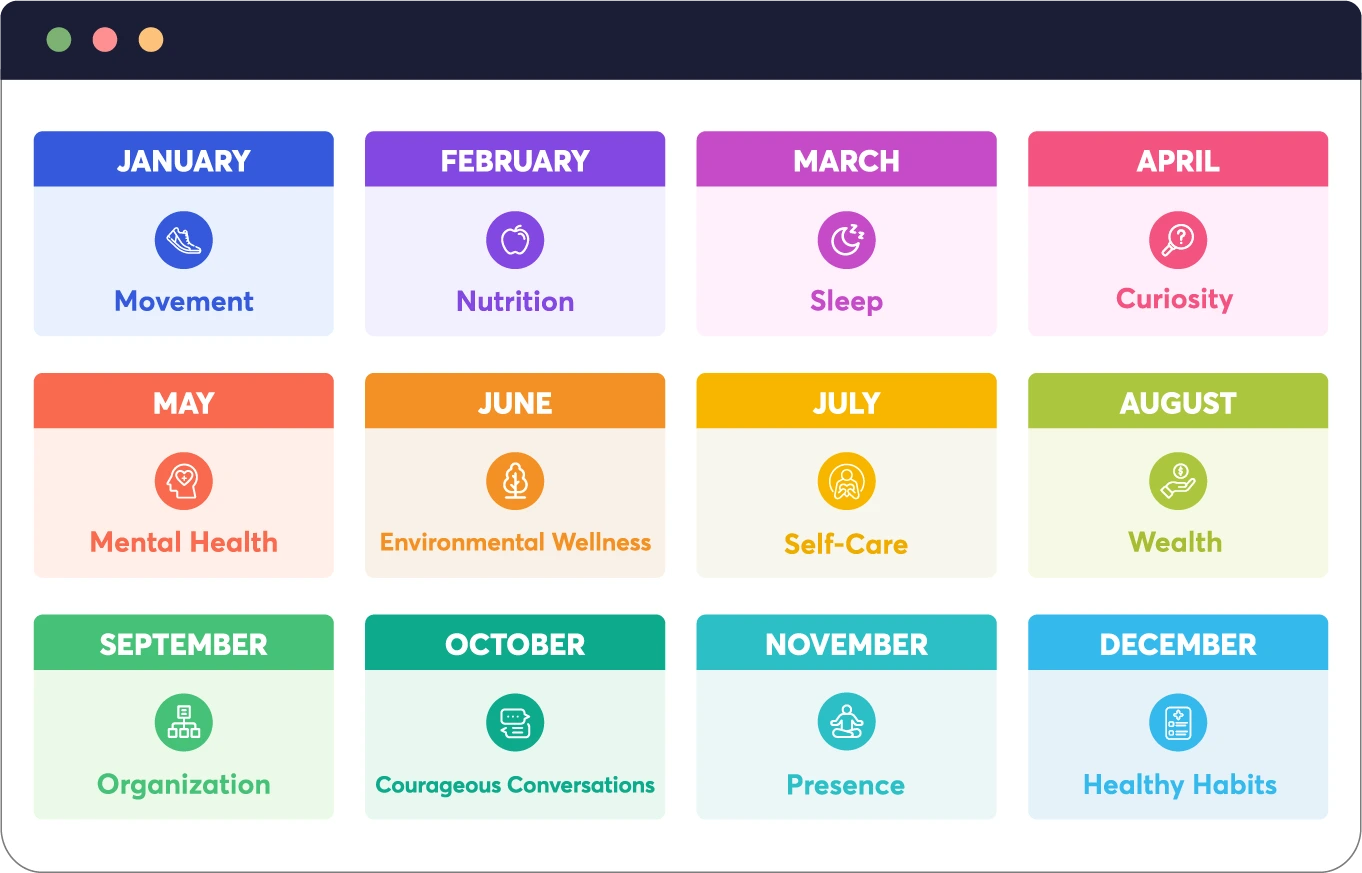
- Align topics with global wellness days: Coordinate wellness themes with global health observances to enhance relevance and engagement, such as Mental Health Awareness Month or World Environment Day.
- Customize content for your population: Adjust wellness content to fit your population’s specific needs and demographics. For example, if you have a large population of parents, you could swap in content focused on work-life balance or stress management around the time of school vacations.
Provide a Variety of Resources
By providing a mix of educational, interactive, and self-paced options, employees can engage in wellness at their own pace while still benefiting from a cohesive, comprehensive program year-round.
-
Cater to different learning styles: Offer a
range of
live events,
on-demand
content, and
educational presentations, providing employees with flexible options to engage in
wellness activities and learn at their convenience. These
resources can cover topics from stress management to
nutrition, promoting holistic health.
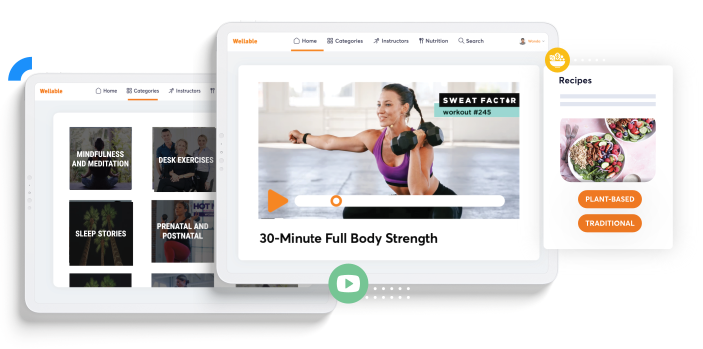
- Centralize wellness resources for easy access: Integrated platforms allow participants to seamlessly engage with events, programs, and resources—reducing friction and boosting participation.
- Integrate wellness with benefits and rewards: Connect wellness resources with employee benefits, recognition programs, and incentives to drive continuous engagement.
Communicate Clearly
Since participants are working toward goals by earning points on a system that remains the same throughout the duration of the entire program, they generally don't need to receive as many emails as they would during a traditional wellness challenge. Emails that are sent out during the month (or whatever the set time period for rewards may be) have a recurring schedule that matches previous and future months, which reduces administrative work and excessive notifications that may bother or overwhelm employees.
- Establish a consistent communication schedule: Send regular, well-timed updates (such as monthly emails or reminders), keeping employees informed without overwhelming their inboxes.
-
 Centralize information:
Reduce email clutter by using a dedicated space to
communicate (e.g., bulletin board, Teams/Slack channel) so
that employees can easily check progress, upcoming
activities, and rewards in one place.
Centralize information:
Reduce email clutter by using a dedicated space to
communicate (e.g., bulletin board, Teams/Slack channel) so
that employees can easily check progress, upcoming
activities, and rewards in one place.
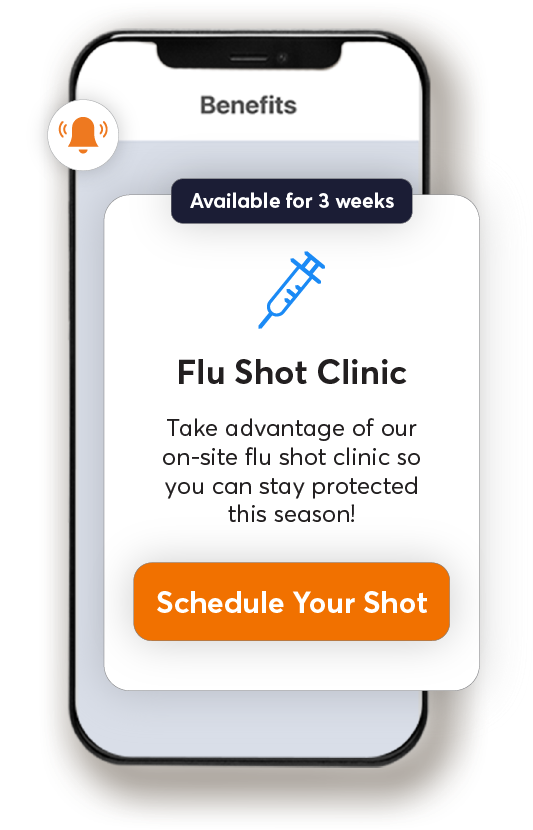
- Leverage in-app notifications: Utilize in-app notifications to deliver timely updates and reminders, allowing employees to engage with program updates directly within the platform. For example, Wellable provides pre-drafted notifications that push relevant on-demand content, like sleep stories during a sleep-focused month, to enhance participation.
Recognize Participation with Rewards
Recognizing participation with rewards is a best practice in continuous wellness programs, as it helps keep employees motivated and engaged over time. Offering meaningful incentives reinforces positive behaviors and provides a sense of accomplishment that fuels consistent involvement. To learn more about selecting the ideal reward structure for your wellness program, check out this article or explore some common best practices below.
- Implement a tiered system: Use a tiered reward structure with multiple attainable milestones to encourage continuous participation, optimizing engagement by ensuring that rewards are both achievable and motivating. If a tiered system isn't feasible due to budget restrictions, consider a "Break The Bank" model where rewards are distributed equally among participants who meet the set point goal.
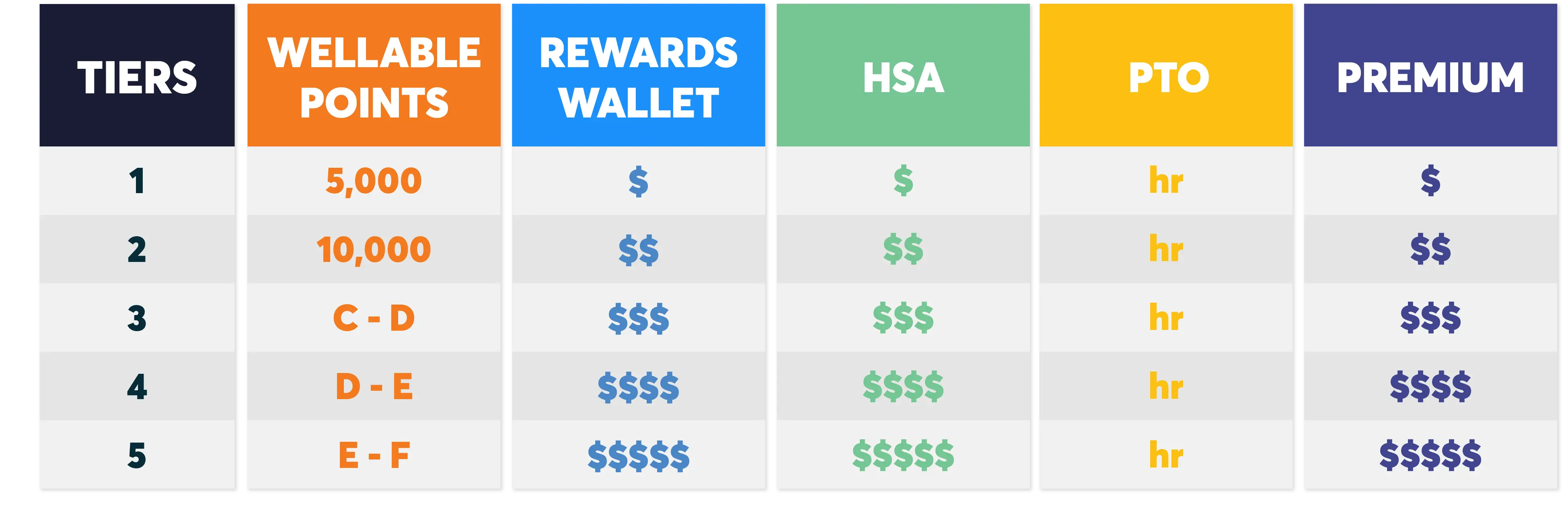
- Distribute rewards frequently: Monthly rewards keep participants motivated and prevent procrastination, making goals feel more achievable and milestones more meaningful. Resetting points each month gives employees frequent opportunities to engage without the pressure of falling behind in annual programs. While some employers opt for annual rewards for simplicity, Wellable’s tools make it easy to manage and distribute monthly rewards, optimizing engagement and maximizing the impact of the rewards budget.
- Offer a variety of incentives: Employers have many incentives to choose from when selecting rewards: cash, gift cards, paid time off, premium differentials, Health Savings Account (HSA) contributions, and more. Wellable’s Rewards Wallet makes it easy for users to earn and redeem rewards from a global collection of nearly 1,000 popular gift card brands.
Concerns over administrative burdens often lead employers to avoid creating diverse rewards offerings. Using a vendor like Wellable can eliminate these issues with offering multiple rewards. Regardless of which types of rewards or how many are offered, it's important that they always align with what employees want as well as an employer's goals.
Conclusion
If a continuous program is right for an employer, working with a software vendor like Wellable can make the process effective and easy by making the best practices feasible and eliminating administrative burdens associated with tracking points and allocating rewards. Wellable’s dedicated Customer Success Management can assist in administering programs, ensuring smooth execution. For both continuous programs or wellness challenges, Wellable can provide monthly health content, deliver rewards, automate emails, track activity, run reports and analytics, and more!